The American Heart Association is currently running its Basic Cardiovascular Sciences (BCVS) Scientific Sessions, and this year it is being held in New Orleans. Both Emily and Su-Yi are presenting their research in poster sessions.
Here is the program: BCVS 2015
A poster session is sort of like a pop-up flea market (a bit more organized) to facilitate the presentation of a large number of studies all at once, allowing meeting attendees to browse around and spend as much time as they wish (or not) looking at the presentations, and also have a chance to speak directly with the lead author. Its also a good opportunity for students and fellows to network and perhaps make connections for future positions. To this day I have colleagues and friends that I met because their poster just happened to be set up next to mine. Below, see Emily after having just set up her poster. Looks like her "neighbor" has not yet arrived.
Posters can be even more challenging to present than a formal lecture, since an entire study needs to be condensed onto a relatively small presentation board (that would be the "poster") in a manner that is clear and comprehensible to a passing audience. It needs to be "catchy" enough so that it grabs the audience's attention, but deliver the message in a clear manner so that one does not need to spend more than about 5 minutes looking it over (unless perhaps its really directly in your area, or even perhaps your competition!). A well done poster can be completely understood, primarily using figures and graphics, rather than text, even if the author is not present to explain it (posters are typically left up for a day or two). It can be exhausting to present a poster, but that would be a good sign (compared to having nobody stop by to discuss it!).
It seems a shame that Emily and Su-Yi had to travel all the way to New Orleans just to spend several days holed up in a convention center doing nothing but talking science. Well actually, ...I suppose they might get a chance to poke around the French Quarter just a bit. I told Emily it was closed this week, but I'm pretty sure she did not believe me. In case that gets out of hand, an early morning visit to Cafe Du Monde should do the trick.
When she returns, Emily will be posting pictures from the lab picnic from last week.
Here is the program: BCVS 2015
A poster session is sort of like a pop-up flea market (a bit more organized) to facilitate the presentation of a large number of studies all at once, allowing meeting attendees to browse around and spend as much time as they wish (or not) looking at the presentations, and also have a chance to speak directly with the lead author. Its also a good opportunity for students and fellows to network and perhaps make connections for future positions. To this day I have colleagues and friends that I met because their poster just happened to be set up next to mine. Below, see Emily after having just set up her poster. Looks like her "neighbor" has not yet arrived.
Posters can be even more challenging to present than a formal lecture, since an entire study needs to be condensed onto a relatively small presentation board (that would be the "poster") in a manner that is clear and comprehensible to a passing audience. It needs to be "catchy" enough so that it grabs the audience's attention, but deliver the message in a clear manner so that one does not need to spend more than about 5 minutes looking it over (unless perhaps its really directly in your area, or even perhaps your competition!). A well done poster can be completely understood, primarily using figures and graphics, rather than text, even if the author is not present to explain it (posters are typically left up for a day or two). It can be exhausting to present a poster, but that would be a good sign (compared to having nobody stop by to discuss it!).
It seems a shame that Emily and Su-Yi had to travel all the way to New Orleans just to spend several days holed up in a convention center doing nothing but talking science. Well actually, ...I suppose they might get a chance to poke around the French Quarter just a bit. I told Emily it was closed this week, but I'm pretty sure she did not believe me. In case that gets out of hand, an early morning visit to Cafe Du Monde should do the trick.
When she returns, Emily will be posting pictures from the lab picnic from last week.
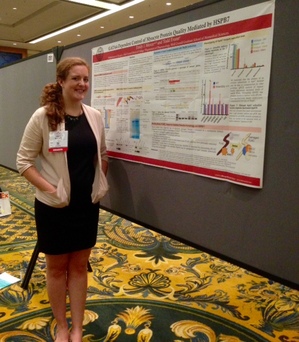
Who Dat?? In New Orleans, Emily will present her poster on the role of the HSPB7 chaperone protein in cardiogenesis (her main PhD thesis topic). Su-Yi is presenting her work on generating cardiac Purkinje Cells from embryonic stem cells. Great job guys!!

 RSS Feed